Elon Musk
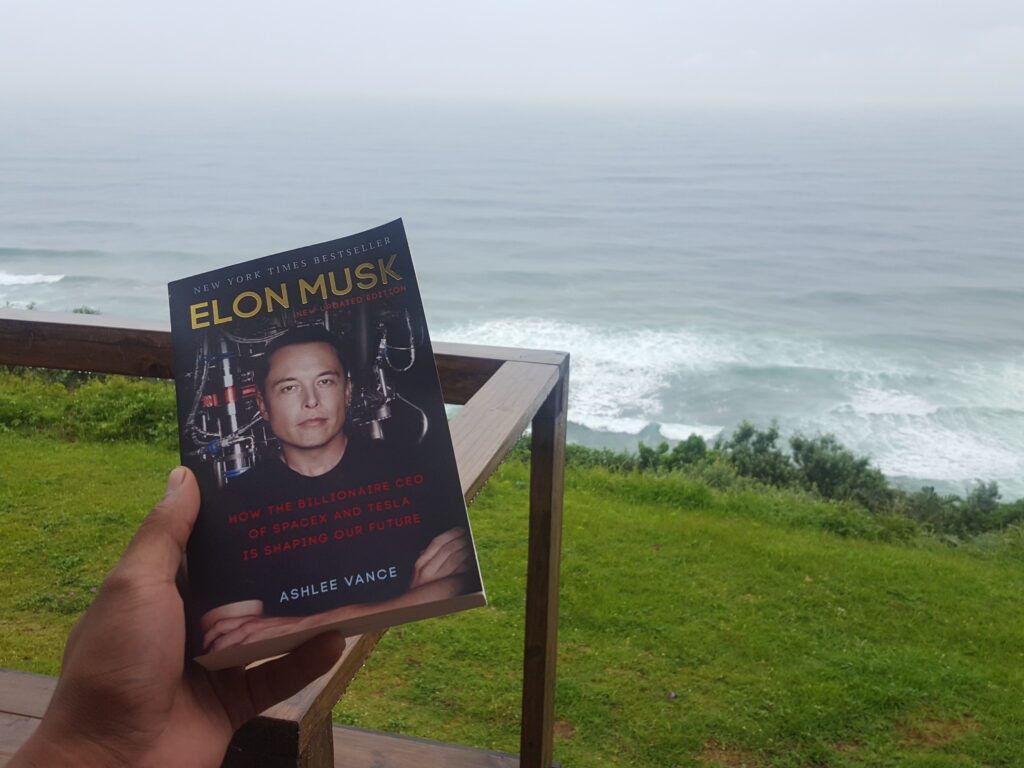
The Journey of Elon Musk: My Experience Reading Ashlee Vance’s Biography
In 2011, just after finishing high school, I stumbled upon a name that would spark a fascination and drive that has stayed with me ever since—Elon Musk. My curiosity about entrepreneurship and business led me to explore the emerging world of electric vehicles. The Tesla Roadster was making waves and being talked about on car shows on television, and I was intrigued. I vividly remember typing “Electric Cars South Africa” into Google, eager to learn more about their availability in my country. Instead, I found myself staring at a Wikipedia page about someone named Elon Musk.
At first, I was irritated—this wasn’t the answer I was looking for. But as I started reading, my irritation quickly turned to astonishment. Elon Musk, the man behind Tesla, and a then small government contractor company called SpaceX, and so much more, was born in South Africa! My jaw literally dropped. It was a moment of realization: if someone from South Africa could make it on such a grand scale, then anything truly was possible. I couldn’t wait to share what I had discovered with my friends and even the architect who was mentoring me at the time. To my surprise, no one seemed to know who he was, and even fewer seemed to care. But that only fueled my fascination further.
Years later, when Ashlee Vance’s biography of Elon Musk came out, I was thrilled. By that time, Elon was orders of magnitude wealthier, and there were countless more videos and articles about him available on the internet. I had been following his story for nearly a decade, eagerly reading every bit of information I could find. So when this book was published, I was more than ready to dive deeper and learn even more about the man who had become such an inspiration to me.
Elon’s upbringing in South Africa was marked by an early fascination with technology and a strong work ethic. Born into a middle-class family with some wealth, Elon’s story shares a common theme with many billionaires: he had the resources to get started, but he used those resources to forge his own path. That’s a strength that often gets overlooked. While others might see wealth as a safety net, Elon saw it as a launchpad. From a young age, he was programming and working with computers, showing the kind of drive that would later define his career.
One story that stands out from his time in South Africa is his determination to seek out the highest-paying jobs that no one else wanted to do. Elon worked in the mines, where the work was grueling, dirty, and dangerous. It wasn’t just about the money—this was Elon’s way of proving his grit, pushing his limits, and showing that he wasn’t afraid of hard work. This early experience in the mines shaped his industrious nature and laid the groundwork for the relentless drive that would later propel him to success.
As Elon’s journey took him from South Africa to Canada, and eventually to the United States, he pursued his studies in business and engineering. But even university couldn’t contain his ambitions. He dropped out to start his own businesses, a decision that seemed reckless to most, but to Elon, it was just the first step in a series of bold moves. One of his earliest ventures was creating a game that he sold at just 12 years old—a clear sign of his entrepreneurial spirit. Later, he co-founded Zip2, a company that provided city guides for newspapers. The sale of Zip2 was one of his first big successes, netting him a substantial amount of money and positioning him to take on even bigger challenges.
Elon used the proceeds from Zip2 to create X.com, which would eventually become PayPal after a series of mergers and rebranding. PayPal was a game-changer, not just for Elon, but for the entire tech industry. The “PayPal Mafia,” a group of former PayPal employees who went on to start or invest in other major tech companies, is a testament to the influence and success of that venture. Elon’s ability to leverage his success at PayPal to fund his next big ideas—SpaceX, Tesla, and SolarCity—demonstrates his strategic thinking and willingness to take risks.
One of the most fascinating parts of Elon’s story is his dealings with Russia when he was trying to obtain supplies for the rockets he wanted to build. Elon met with brokers and foreign officials in Russia, negotiating to purchase Intercontinental Ballistic Missile (ICBM) structures. His goal was to repurpose these into the rockets that would later become the foundation of SpaceX. The risks he took were enormous, almost insane. He was venturing into uncharted territory, taking on the established aerospace industry, and betting everything he had on a vision that few could even comprehend.
Elon’s strategy wasn’t just about building companies from scratch; he also knew the value of acquiring existing ones and growing them. By purchasing companies and investing in their development, he multiplied his wealth exponentially. This concept of using capital to accelerate growth is something I learned from another billionaire, Eike Batista, who believed that the letter “X” represented the multiplication of wealth. Elon’s approach to business, leveraging his success to fuel further success, is a powerful example of how to think big and act boldly.
However, the path was far from easy. The 2008 financial crisis hit Elon hard. Tesla, SpaceX, and SolarCity were all struggling, and Elon was on the verge of a nervous breakdown. He poured his last dollars into keeping his companies afloat, losing vast amounts of money and sleep in the process. When asked what it felt like, Elon famously said that he would rather chew on broken glass than go through that kind of pain again. It was truly a dark night of the soul, a period where everything was on the line, and the odds seemed insurmountable. But Elon’s story is one of survival and resilience. He didn’t just face challenges—he confronted them head-on, refusing to accept failure as an option.
What resonates most with me is Elon’s mindset—the belief that failure is not an endpoint but a stepping stone. This is a lesson I’ve taken to heart in my own life. Growing up, I faced my own set of challenges. I was determined to create a better life for myself, but that decision came at a cost. My beliefs clashed with those of my family, who held onto their ideologies, which often surfaced as conflict. I couldn’t accept those beliefs—I saw them as out of touch with reality. The emotional and physical abuse that resulted from this conflict became too much to bear, and I had to fight to break free. I took risks, and as a result, I became an outsider and an outcast. But like Elon, I saw those challenges as opportunities to forge my own path. I refused to let the negativity of others dictate my future.
Elon Musk’s journey is one of relentless pursuit of his goals, no matter the cost. His story, as detailed in Ashlee Vance’s biography, is a testament to the power of resilience, critical thinking, and an unyielding belief in one’s vision. It’s a story that has inspired me to keep pushing forward, to take risks, and to never accept no for an answer. Reading this book was more than just learning about Elon Musk—it was a reminder that, no matter where you come from, if you’re willing to fight for your dreams and take advantage of the resources at your disposal, anything is possible.